Finish
What is Diasec® and why do I use it?
A botanical artwork lives through light, depth and stillness. That is why I do not produce my dark botanical fine art photography as loose posters, but as finished objects behind acrylic glass and on dibond. Framing is available only on request.
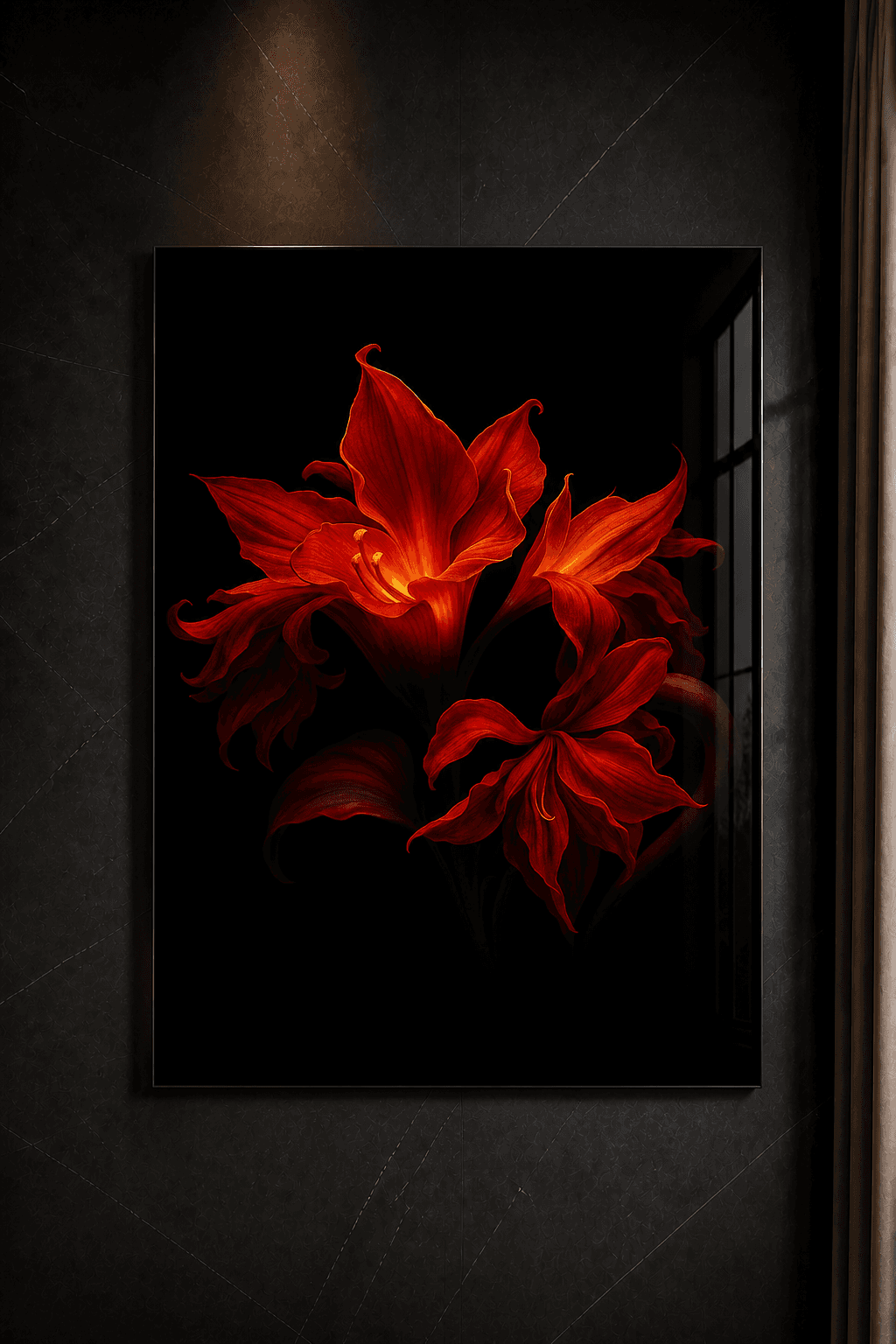
Diasec® is the finishing method in which the photographic print is face-mounted behind optically clear acrylic glass. The image is not simply placed behind a loose sheet of glass; image and surface become one calm front. For my work this matters, because many flowers emerge from a near-black field. A small distance, reflection or cheap shine can break that stillness quickly.
I choose this finish not because it is louder, but because it is more precise. Dark areas gain depth, fine edges remain visible and the flower gains the presence of an object. That suits the premise of Beate Marie Photography: a transient flower does not become a poster, but a lasting artwork that can be collected as a limited edition or unique piece.
What Diasec actually does
The core is the face-mounting. With a traditionally framed print, there is often a small optical distance between paper and glass. That distance can add dust, reflection and separation. With Diasec®, the image is mounted directly behind acrylic glass, keeping the front tight and closed. Colour appears closer to the surface.
Behind the image, a stable backing is used; across the current works this is a dibond panel or comparable professional system. It prevents a large work from feeling loose or temporary. The object gains weight, flatness and a clear technical back. For large formats this is not a detail, but part of the experience.
The transition into the room stays quiet through the Diasec® object itself. A frame is available only on request and is only placed when that has been agreed personally.
Why it suits dark botanical work
I do not treat flowers as illustrations. I photograph them as portraits: sometimes frontal, sometimes almost withdrawn, often with a large field of darkness around the petal, stem or flame of the flower. In such an image, material is never neutral. It determines whether a red edge becomes harsh, whether yellow keeps breathing, or whether a black background remains truly dark without becoming dead.
Diasec® helps especially with that tension between darkness and light. In Phoenix, a parrot tulip comes forward as if still moving. In Scarlet Duo, two tulips need to remain both physical and still. In Golden Column, the vertical flower form must not become decoratively flat. The finish has to carry this tension without pulling attention away from it.
That is why Diasec® is not a luxury word for me. It is a choice for calm, protection and presence. The finish should help a collector look longer, not buy faster.
What you receive as a collector
A current work consists of a fine art pigment print, Diasec® finishing behind acrylic glass, a stable backing and certificate of authenticity. The price is discussed personally. Framing is available only on request and is not a fixed part of the finish.
Planning is confirmed after the inquiry. Each work is then produced and finished carefully. Delivery and insurance are arranged individually.
The edition remains the promise. A work of 3/3 or 5/5 is not issued indefinitely. A unique work, such as Phoenix, requires even more personal alignment around availability and transport.
When Diasec is the right choice
Diasec® is especially suitable when the work itself asks for clarity, depth and physical calm. Dark botanical photography often has an almost silent background. The eye should not get caught in paper texture, glass distance or a busy frame. The finish should let the flower come forward and then disappear.
For interiors this means the work has to function both up close and from a distance. Up close, you see the edge of a petal and the transition from light to shadow. From a distance, the object should carry the room without taking it over. This is exactly where the difference between a print and a finished artwork becomes visible.